
The construction industry enters 2026 under real pressure labor shortages are intensifying, material costs remain volatile, and owners are asking for more accountability on every dollar. In this environment, BIM has become one of the few tools that directly answers all three problems at once but only when general contractors actually own the process.
The Real Reason BIM Is Non-Negotiable for GCs Right Now
The conversation around BIM adoption in the U.S. has shifted. For years, GCs could position BIM as a value-add something that differentiated your firm when competing for sophisticated owners. That window is closing fast.
Federal agencies including the GSA, the U.S. Army Corps of Engineers, and the Department of Veterans Affairs have had BIM requirements in place for years. What is new in 2026 is the downstream effect large private owners healthcare systems, data center developers, university systems, and industrial clients are now embedding BIM deliverable requirements directly into GC contracts, often including specific LOD benchmarks, Common Data Environment requirements, and as-built model handover specifications.
There is also a competitive reality at play. According to the 2026 construction outlook from multiple industry sources, BIM specialists command 25 to 30 percent wage premiums over comparable roles, reflecting how tightly skilled VDC talent is tied to project competitiveness. GCs who cannot attract or develop this talent are increasingly disadvantaged on major bids.
Where GCs Are Actually Losing Money Due to BIM Mismanagement
Accepting a BIM Execution Plan That Was Written for the Design Team
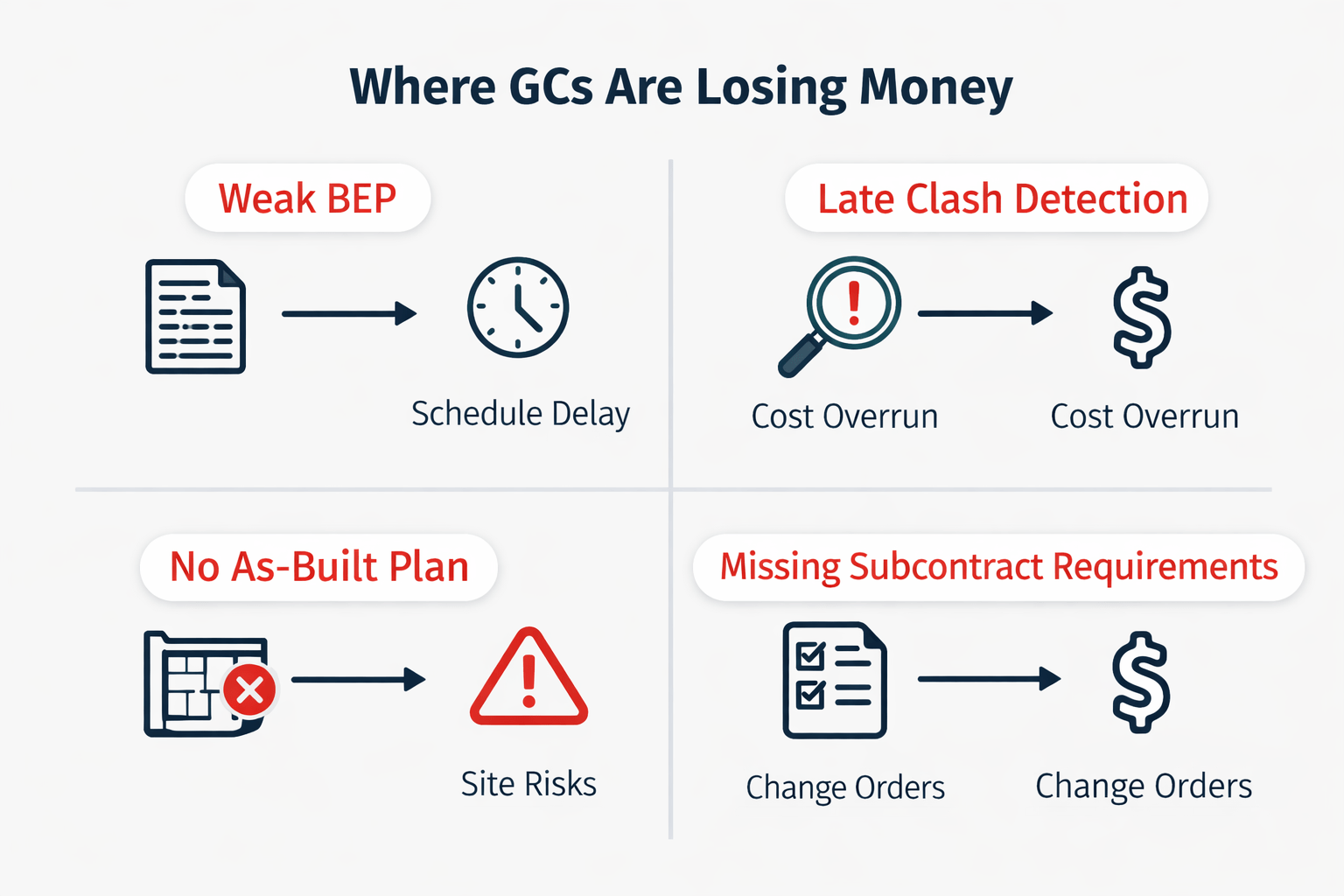
The BIM Execution Plan should be authored or co-authored by the GC. When a GC simply accepts the architect’s BEP, it often lacks the field-facing requirements that matter during construction fabrication model deliverables from trade contractors, field verification protocols, as-built update schedules, and clash resolution ownership. The result is a coordination process that serves design documentation but not construction execution.
Clash Detection Run Too Late in the Schedule
Clash detection has the highest ROI when it is completed before procurement and subcontractor mobilization. GCs who run coordination sessions after shop drawings are issued or worse, after fabrication has begun effectively convert a model-based problem into a field problem with a higher resolution cost. On a 300,000-square-foot commercial project, resolving clashes in the model typically costs a fraction of resolving them in the field, where the ratio of model cost to field cost is commonly cited at 1:10 or higher.
No Plan for the As-Built Model at Contract Execution
As-built BIM handover is now a contract requirement on a growing share of U.S. projects, particularly those involving healthcare, federal, and higher education owners. GCs who do not capture field deviations throughout construction face a costly data reconciliation effort at closeout or worse, a contract dispute over a deliverable they did not budget for. The time to plan for as-built delivery is during preconstruction, not 30 days before substantial completion.
Not Requiring BIM Deliverables in Subcontracts
A GC can have a strong internal BIM capability and still fail at coordination if trade contractors are not contractually required to produce and maintain their own models. MEP subcontractors in particular need to deliver fabrication-ready BIM models for ductwork, piping, and conduit. When these requirements are absent from subcontracts, the GC ends up modeling subcontractor work themselves or absorbing the coordination risk when gaps emerge in the field.
BIM and the Labor Shortage: A Connection Most GCs Are Missing

The U.S. construction industry faces a skilled labor shortage that is expected to require hundreds of thousands of additional workers by the mid-2020s. This shortage is not just about craft labor on the job site it is also driving a shortage of experienced field supervisors and project engineers who know how to execute complex work without rework loops.
BIM directly addresses this in ways that are often underappreciated by GCs who think of it primarily as a coordination tool.
- Prefabrication enabled by BIM reduces field labor hours on the most congested and difficult-to-access work, particularly MEP installations in mechanical rooms and overhead coordination zones. When subcontractors fabricate from LOD 400 models, field installation becomes an assembly task rather than a craft task meaning less experienced workers can complete it accurately.
- 4D construction sequencing helps leaner field crews work more efficiently by eliminating idle time and improving material delivery sequencing. Crews that know exactly what is being installed, in what order, and what materials they need have fewer unproductive hours.
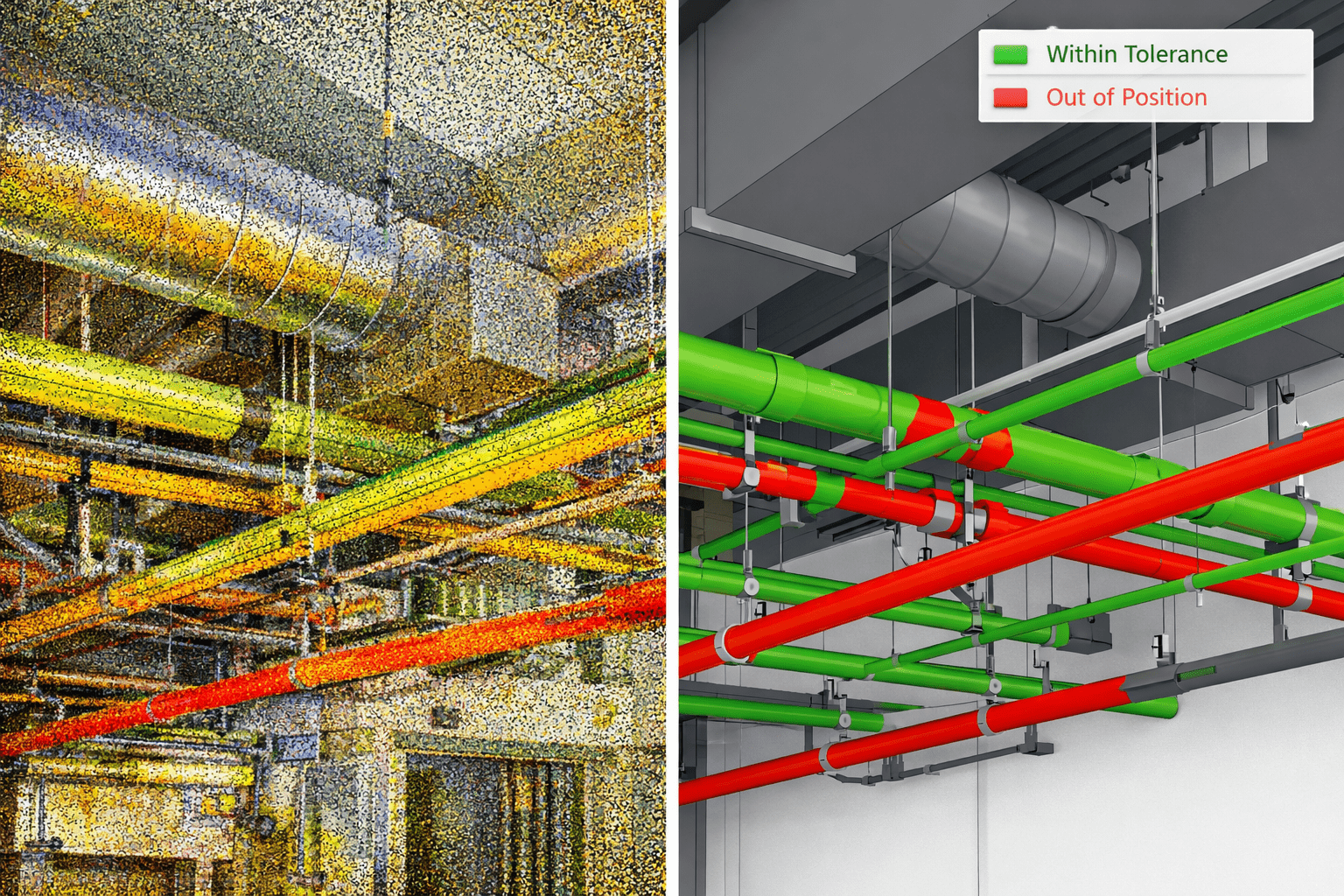
- Scan-to-BIM progress verification reduces the number of supervisory visits needed for quality confirmation. Rather than relying on experienced eyes to assess whether work is installed correctly, point cloud comparisons against the model can identify deviations quantifiably and early.
5 Project Phases in BIM For General Contractors
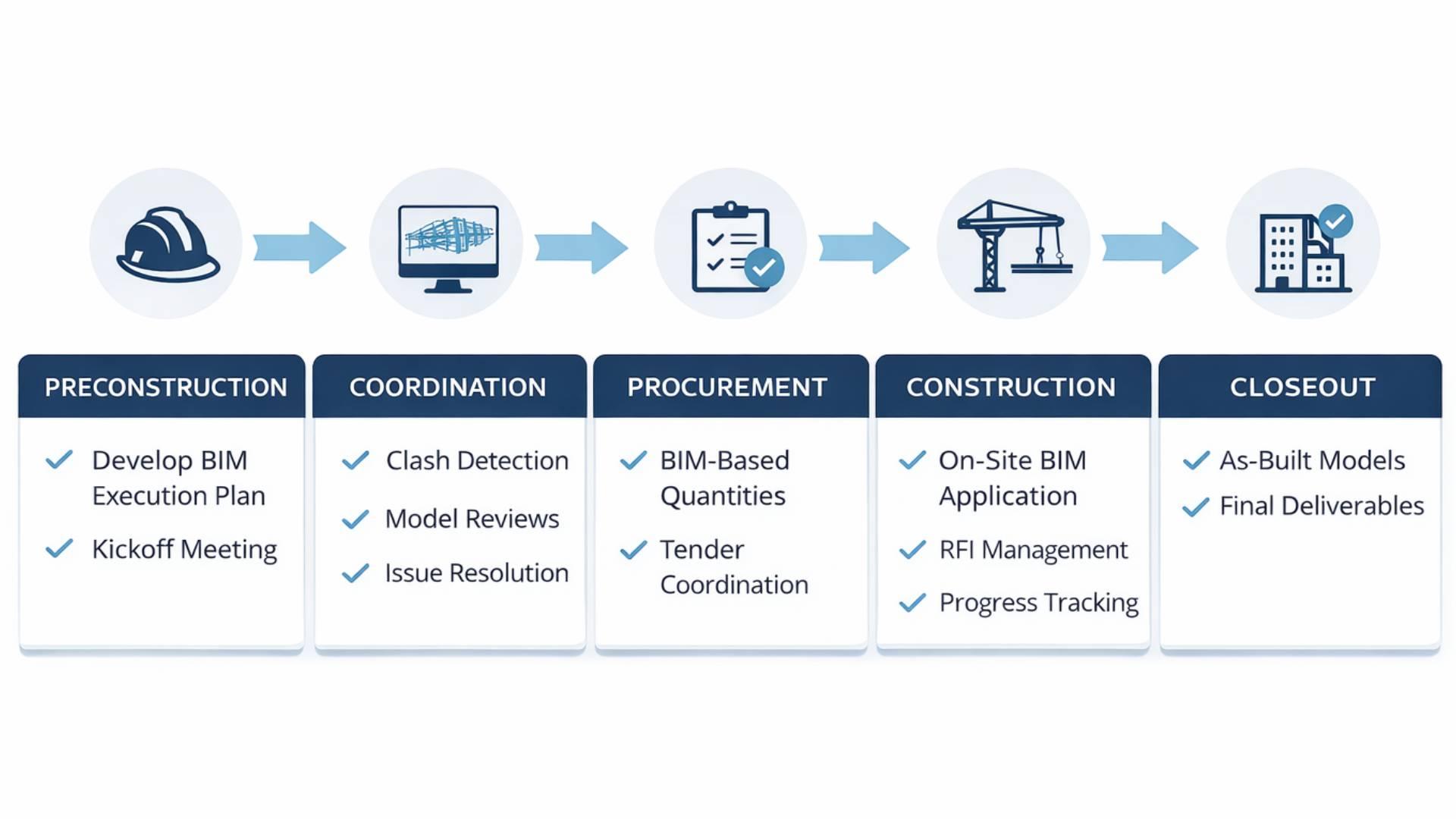
The GC’s Role in BIM: What You Must Own on Every Project
On a design-bid-build project, the architect typically initiates the BIM model. On a design-build or CM-at-risk project, the GC often drives it from the start. In either case, there are specific BIM responsibilities that general contractors should own regardless of project delivery method.
The BIM Execution Plan
The BEP is the governing document for how BIM is managed on a project. It defines model authoring responsibilities, software platforms, file naming conventions, coordination meeting cadence, and handover requirements. GCs should contribute to the BEP during preconstruction and ensure it reflects construction-phase needs not just design-phase deliverables.
Common Data Environment Management
The CDE is the shared digital workspace where all project models, drawings, RFIs, and submittals live. GCs should select and manage the CDE platform rather than defaulting to whatever the design team already uses. Autodesk Construction Cloud, Procore, and Trimble Connect are widely deployed platforms in the U.S. market. The CDE needs to be set up with proper access controls, version management, and naming protocols before design documents start flowing.
LOD Requirements in Subcontracts
Level of Development defines how much geometric and non-geometric information a model element contains. LOD 300 is the standard for construction coordination; LOD 400 is required for fabrication LOD 500 is the as-built standard for owner handover. GCs must specify the LOD required from each trade contractor at each phase and enforce it contractually. Without this, coordination meetings become arguments about what each party was supposed to model.
Clash Detection Ownership
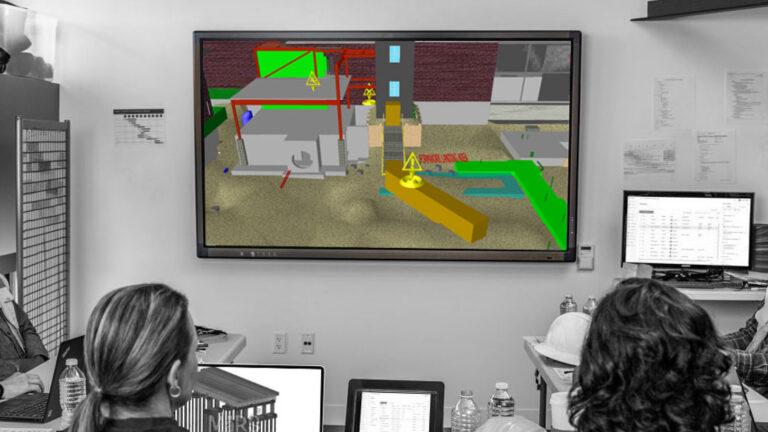
The GC should assign a dedicated VDC coordinator who owns the clash detection workflow. This person federates incoming models from each discipline, runs automated clash checks using tools like Autodesk Navisworks, documents unresolved clashes, and drives weekly coordination meetings where trade contractors resolve conflicts. Leaving clash detection to the design team or to no one in particular is a common and expensive mistake.
What BIM Technology Actually Looks Like on a U.S. Job Site in 2026
BIM in 2026 is not just something that happens in an office during preconstruction. The technology has moved to the field, and GCs who are not using these tools are leaving measurable value behind.
Scan-to-BIM for Progress Verification
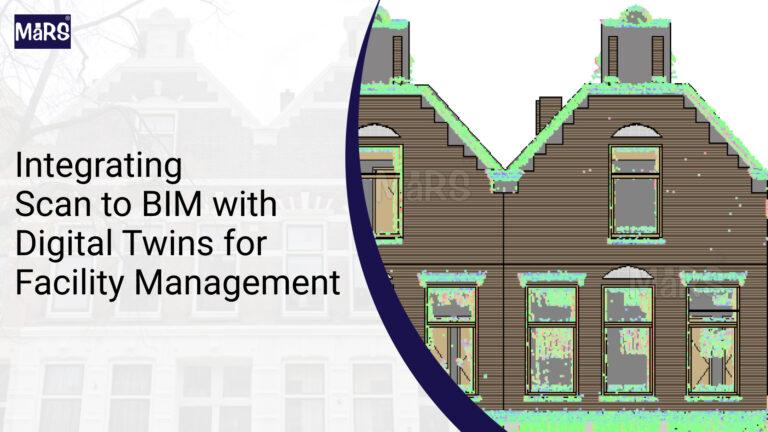
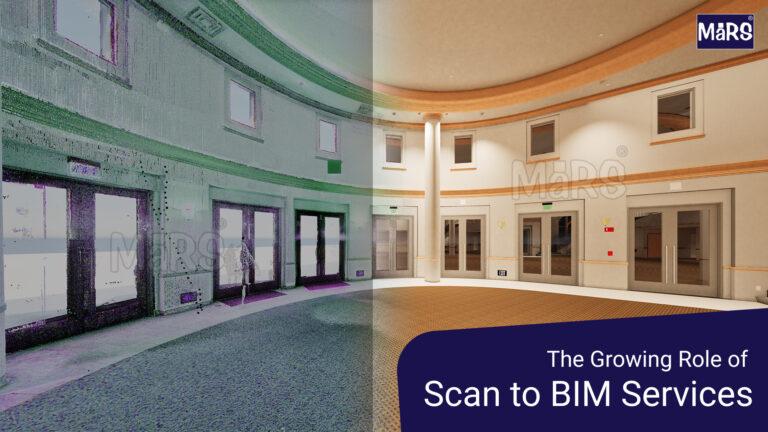
Laser scanning using tools from manufacturers like Leica and FARO can capture an entire floor of a building in a matter of hours. The resulting point cloud is compared against the BIM model to identify deviations: installations that are out of position, missing work, or conditions that have changed since the last model update. This workflow is now practical for mid-size GCs and is increasingly used for weekly progress documentation on complex projects.
AI-Augmented Coordination
Artificial intelligence is now built into leading BIM platforms rather than sold as a separate add-on. AI tools can flag high-probability clash zones before formal coordination runs, suggest sequencing optimizations based on similar project data, and automatically classify and route RFIs based on model element type. GCs should expect these capabilities to be standard features of platform subscriptions they already pay for the question is whether their teams are trained to use them.
Mixed Reality on the Job Site
Augmented reality headsets and tablet-based AR tools allow field supervisors to overlay the BIM model onto the physical space they are standing in. This is particularly useful for MEP rough-in verification, embedded anchor layout, and pre-installation reviews of tight coordination zones. While still maturing, AR adoption among larger GCs has accelerated and the hardware cost barrier has dropped significantly since 2023.
Digital Twin Handover
Owners of complex assets data centers, hospitals, university campuses are increasingly requesting a digital twin at project handover: a live, data-connected model that supports facility management, energy monitoring, and predictive maintenance. GCs who deliver a verified LOD 500 as-built model with properly structured COBie data are positioned to meet this requirement. Those who do not plan for it during construction face a painful closeout scramble.
BIM Contract Risk: What Every GC’s Legal Team Needs to Review

BIM creates liability exposure that standard construction contracts were not written to address. This is one of the most underestimated risk areas for GCs who are active BIM users.
When a GC-Coordinated model is used to resolve a design conflict or to produce trade contractor fabrication drawings, the question of design liability shifts in ways that AIA standard forms may not adequately cover. If the model contains an error that results in a field problem, ownership of that error can be disputed between the GC, the trade contractor, and the design team with consequences for professional liability insurance.
- ConsensusDocs 301 is the most GC-favorable BIM addendum available in the U.S. market and provides a practical starting point for contract negotiations on BIM-intensive projects.
- Model ownership and intellectual property rights should be addressed explicitly, particularly who owns the as-built model and what the owner can do with it after handover.
- The legal status of the BIM model versus the contract documents should be defined clearly. Unless stated otherwise, the drawings typically govern — which means model-based coordination decisions that deviate from the drawings can create change order disputes.
- Insurance review: Confirm that your general liability and professional liability coverage addresses BIM coordination activities, particularly if your VDC team is making design-level decisions to resolve clashes.
A Practical BIM Action Plan for General Contractors in 2026
The GCs who are ahead on BIM did not get there by deploying every available technology at once. They focused, built internal capability deliberately, and tied BIM to specific business outcomes. Here is a practical framework organized by where your firm is today.
If Your Firm Is Just Starting With BIM
- Hire or designate one VDC coordinator as your internal BIM lead. This person does not need to be a software expert on day one they need project experience and the ability to drive process across multiple subcontractors.
- Select a single CDE platform and standardize on it across all projects above a defined project value threshold. Consistency matters more than which platform you choose.
- Add BIM coordination requirements to your standard subcontract terms for MEP trades on projects over $5 million. Specify LOD requirements and coordination meeting participation expectations explicitly.
If Your Firm Already Uses BIM for Coordination
- Audit your BEP template. If it was written by the design team or copied from another project, it likely lacks the construction-phase requirements described in this article. Rewrite it to reflect what you actually need from trade contractors during construction.
- Implement Scan to BIM Services on one current project as a progress verification pilot. The data will justify the investment for the next project.
- Review your subcontract language on LOD requirements and as-built deliverables. These are the two areas most likely to create disputes at closeout.
If Your Firm Has Strong BIM Capabilities
- Develop a digital twin handover capability. Identify one owner client who would value it, build the COBie data structure into your next project’s BIM workflow, and deliver it as a differentiator at closeout.
- Integrate BIM-derived quantity data with your estimating system to improve bid accuracy and close the feedback loop between estimated and actual quantities.
- Evaluate AI tools within your existing BIM platform subscriptions. Most GCs are paying for capabilities they are not using.
Quick Reference: BIM Responsibilities by Project Phase
The table below summarizes GC BIM ownership responsibilities across the key project phases.
| Project Phase | GC BIM Responsibility |
| Preconstruction | Co-author BEP, set up CDE, specify LOD in subcontracts, run early clash detection |
| Design / Coordination | Federate models, weekly VDC coordination meetings, document clash resolutions |
| Procurement | Verify fabrication-ready (LOD 400) models from trade contractors before release |
| Construction | Field verification vs. model, scan-to-BIM progress checks, capture field deviations |
| Closeout / Handover | Reconcile as-built model to LOD 500, prepare COBie data, deliver to owner |
Key Takeaways for General Contractors in 2026
- BIM adoption is no longer driven by owner preference alone federal agencies and major private owners are embedding specific BIM deliverable requirements in GC contracts. Know what you are agreeing to before signing.
- The most common and costly BIM failures for GCs are process failures: accepting a weak BEP, running clash detection too late, and failing to require model deliverables from subcontractors in writing.
- In a labor-constrained market, BIM’s biggest underappreciated value is as a workforce multiplier enabling prefabrication and reducing rework dependency on experienced craft labor.
- Scan-to-BIM, AI-augmented coordination, and mixed reality are now practical field tools, not future technology. GCs on complex projects should be deploying at least one of these today.
- BIM creates contract liability that standard forms do not fully address. Review your BEP, subcontracts, model ownership clauses, and insurance coverage before your next major project.