
In the ever-evolving AEC industry, digital transformation is no longer optional — it’s essential. Among the innovations leading this change, MEP BIM Services have emerged as a critical factor in improving project coordination, accuracy, and efficiency. Whether it’s a high-rise building, a hospital, or an industrial facility, MEP systems form the backbone of modern structures. Integrating these systems through BIM ensures precise planning, seamless execution, and long-term operational efficiency.
This blog explores how MEP BIM Services in USA are revolutionizing construction workflows, the advantages they offer, and why they have become indispensable for engineers, architects, and contractors.
Understanding MEP BIM Services
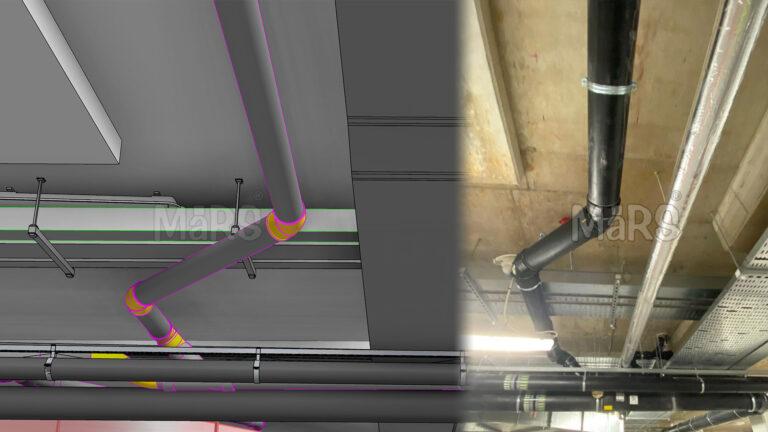
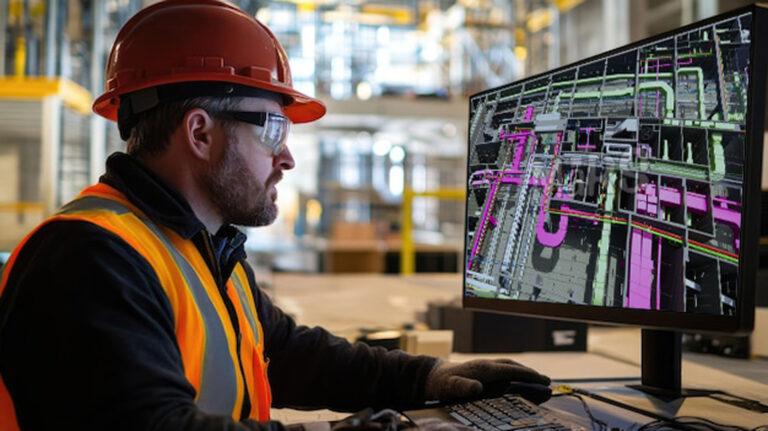
MEP BIM Modeling is the process of creating accurate 3D digital representations of building systems. These intelligent models contain detailed information about every mechanical, electrical, and plumbing component—allowing all disciplines to collaborate in a shared digital environment.
Unlike traditional 2D drafting, MEP BIM enables professionals to visualize the design in three dimensions, analyze performance, detect clashes, and make data-driven decisions throughout the project lifecycle.
A typical MEP BIM model includes:
-
HVAC layouts and duct systems
-
Electrical wiring, lighting, and power distribution
-
Plumbing and drainage networks
-
Fire protection systems
-
Equipment locations and access zones
This integration allows stakeholders to predict issues early, streamline coordination, and ensure that construction aligns perfectly with design intent.
Why MEP BIM Services are Essential in Modern Construction
-
Enhanced Coordination Across Disciplines
In a construction project, different teams — architectural, structural, and MEP — work on interconnected elements. MEP BIM ensures that all systems are coordinated within a single model, minimizing design conflicts and optimizing available space. This reduces project delays and on-site rework significantly. -
Clash Detection and Resolution
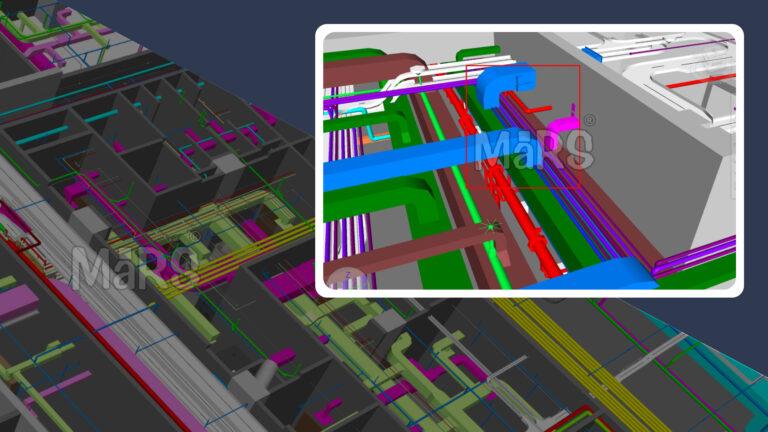
One of the most valuable features of MEP BIM is its ability to identify spatial conflicts between building elements before construction begins. Automated clash detection tools highlight potential collisions between ducts, pipes, beams, and cables, allowing teams to resolve issues virtually instead of physically on-site. -
Accurate Fabrication and Installation
Fabrication drawings generated from MEP BIM models are highly detailed and precise. They help fabricators cut, assemble, and install systems with confidence. This reduces errors, waste, and costly rework during installation. -
Energy Efficiency and Sustainability
With the growing demand for green and energy-efficient buildings, MEP BIM helps engineers simulate and analyze system performance. It allows for accurate load calculations, ventilation optimization, and energy modeling — ensuring buildings meet LEED or other sustainability standards. -
Lifecycle Management and Maintenance
BIM isn’t just about design and construction; it also supports facility management. The MEP model can be integrated with operation and maintenance (O&M) systems, enabling facility managers to access equipment data, maintenance schedules, and performance history for long-term efficiency.
Key Benefits of MEP BIM Services in USA
1. Precision and Accuracy
Every pipe, cable, and duct is digitally represented in 3D, ensuring millimeter-level accuracy. This precision leads to higher-quality construction and a reduction in field modifications.
2. Cost and Time Savings
By identifying design clashes early and minimizing rework, MEP BIM reduces both project timelines and overall costs. Prefabrication based on BIM data further accelerates project delivery.
3. Improved Collaboration
Cloud-based BIM platforms such as Autodesk Revit, Navisworks, and BIM 360 enable real-time collaboration among teams across different locations. This transparency keeps everyone aligned with the project goals.
4. Risk Mitigation
Accurate visualization of MEP systems before construction minimizes unexpected site issues. Project managers can plan logistics, sequencing, and coordination effectively, reducing potential risks.
5. Better Documentation and Record Keeping
MEP BIM models serve as a digital record of all systems installed in the building. This helps in future renovations, upgrades, or facility operations, ensuring every element is traceable and accessible.
Applications of MEP BIM Services
-
Commercial Buildings
Large commercial facilities such as offices, shopping complexes, and hotels require precise MEP BIM coordination to handle complex HVAC, electrical, and plumbing systems. BIM ensures smooth integration and efficient space utilization. -
Healthcare Facilities
Hospitals and medical centers rely on highly efficient systems for air circulation, sanitation, and power backup. MEP BIM helps ensure compliance with strict healthcare standards while minimizing operational interruptions. -
Educational Institutions
Schools and universities benefit from MEP BIM through improved design of energy-efficient lighting, HVAC systems, and plumbing networks, ensuring comfortable and sustainable learning environments. -
Industrial and Manufacturing Plants
In industrial settings, MEP BIM assists in designing intricate utility networks, fire protection systems, and process piping layouts with high precision. -
Residential Complexes
From high-rise apartments to housing developments, MEP BIM ensures reliable and efficient systems for comfort, safety, and sustainability.
MEP BIM Workflow – Step by Step
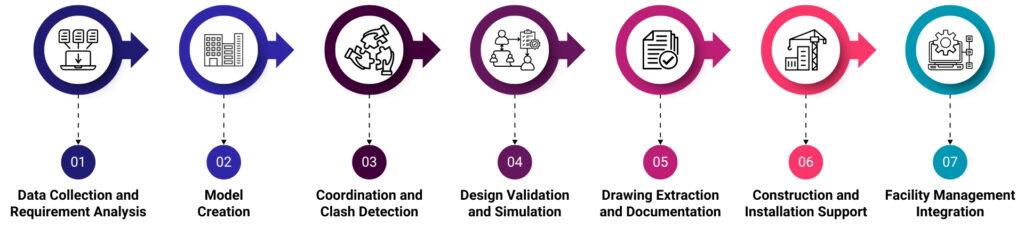
A well-structured MEP BIM workflow typically includes the following stages:
-
Data Collection and Requirement Analysis
The process begins with gathering architectural and structural inputs such as floor plans, sections, and elevations. Engineers analyze the project requirements, codes, and design intent. -
Model Creation
Using software like Revit, MEP engineers create 3D models for mechanical, electrical, and plumbing systems. These models are built with accurate parameters for components and materials. -
Coordination and Clash Detection
The individual MEP models are integrated with architectural and structural BIM models. Advanced tools like Navisworks are used for clash detection and resolution. -
Design Validation and Simulation
The integrated model is tested for performance, pressure, airflow, voltage, and load calculations to ensure system efficiency and compliance. -
Drawing Extraction and Documentation
Once validated, detailed fabrication drawings, installation plans, and shop drawings are extracted directly from the BIM model. These ensure that on-site execution matches the design perfectly. -
Construction and Installation Support
During construction, BIM data guides on-site teams through precise installation. Any design changes made are automatically reflected in the model. -
Facility Management Integration
After project completion, the as-built MEP BIM model is handed over to facility managers. It serves as a reference for maintenance, repairs, and future upgrades.
Role of MEP BIM in Sustainable Building Design
Sustainability is a top priority for construction in the USA. MEP BIM contributes significantly by enabling energy simulations, material optimization, and system efficiency analysis.
-
HVAC modeling helps reduce energy consumption by optimizing airflow and insulation.
-
Electrical system modeling assists in efficient lighting layouts and renewable energy integration.
-
Plumbing modeling enables water recycling and smart system design.
These analyses support LEED certification and other sustainability benchmarks, making MEP BIM Services a key enabler of eco-friendly construction.
Future of MEP BIM Services in USA
The future of MEP BIM in the United States is promising, as more firms adopt Digital Twin Technology and AI-driven BIM automation. The integration of IoT (Internet of Things) with BIM models allows real-time monitoring of building systems, leading to predictive maintenance and operational efficiency.
Moreover, advancements in 4D (time) and 5D Cost BIM modeling now allow project managers to simulate construction schedules and estimate costs directly from MEP models, making the planning process more reliable and data-driven.
As government regulations and clients increasingly demand BIM deliverables, the need for MEP BIM expertise will continue to grow — positioning it as a cornerstone of digital construction in the USA.
Conclusion
The adoption of MEP BIM Services in USA is transforming how buildings are designed, constructed, and maintained. By fostering collaboration, minimizing errors, improving energy efficiency, and reducing costs, MEP BIM empowers project stakeholders to deliver smarter, more sustainable buildings.
From concept to facility management, MEP BIM creates a digital bridge that enhances every stage of a building’s lifecycle. In today’s competitive construction environment, embracing MEP BIM is not just a technological advantage—it’s a strategic necessity for achieving excellence in project delivery and long-term operational success.